Background. Regular gait analysis could enhance personalised treatment for many movement-related conditions; however, it is not routinely integrated into clinical care. Although mobile sensing (e.g. smartphone-based motion capture) enables rapid gait assessment, extracting actionable insights remains a challenge.
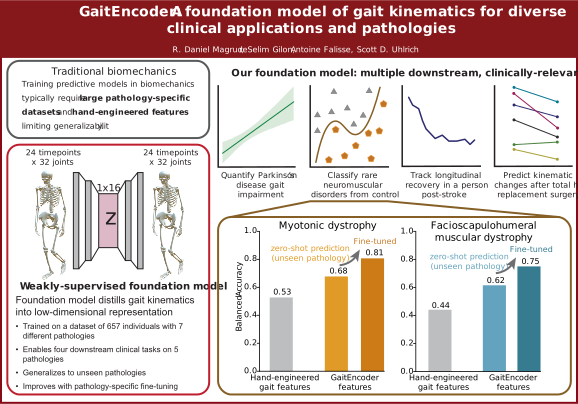
Objective. We introduce GaitEncoder, a generative foundation model that encodes high-dimensional 3D gait kinematics into a compact 16-dimensional latent space and enables clinically meaningful downstream tasks across diverse pathologies.
Methods. We aggregated eight datasets comprising 657 individuals (age 8-86) spanning seven pathologies and trained a weakly-supervised variational autoencoder. We evaluated the clinical utility of this model on multiple various downstream tasks.
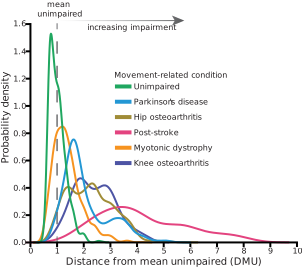
Results. We show that this representation enables four downstream clinical tasks across both in- and out-of-distribution pathologies, with and without model fine-tuning, including: 1) classification of neuromuscular disorders unseen during training, 2) predicting clinical severity scores for individuals with Parkinson’s Disease, 3) tracking of subacute recovery post-stroke, and 4) generating patient-specific kinematic changes following total hip arthroplasty. Our model also computes a Distance from Mean Unimpaired (DMU) score, a scalar metric that captures an individual’s deviation from typical unimpaired gait for rapid quantification of impairment.
Significance. Our GaitEncoder provides a generalizable representation which may accelerate the development of clinical tools for monitoring disease progression, guiding rehabilitation, and informing surgical decisions, particularly for rare movement-related disorders.